
How I Interpret CTX and P1NP (And Why I Built This Tool in BonePilot)
The Question I Keep Getting Asked
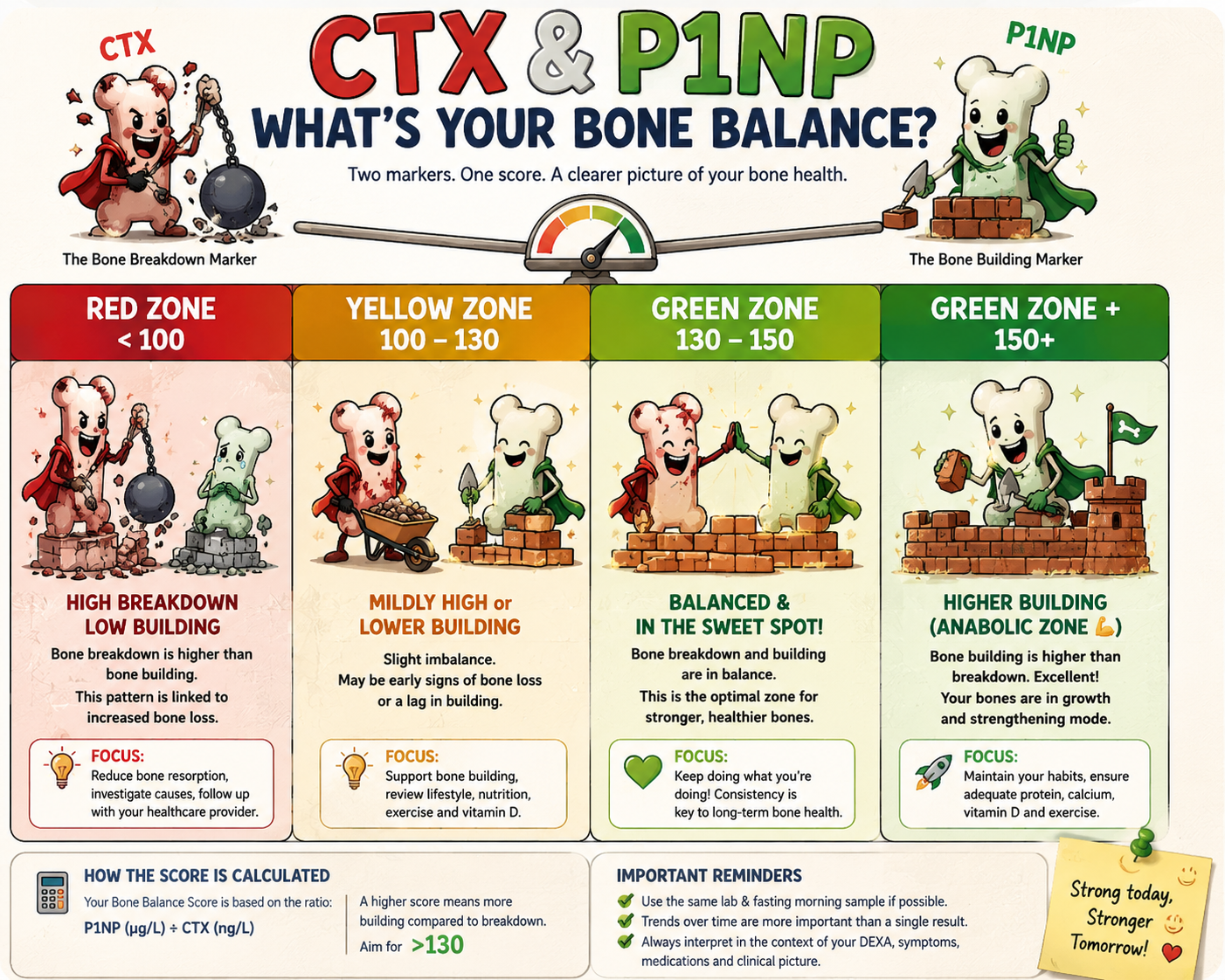
Over the past few months, one question has come up more than almost any other: "I've had my CTX and P1NP measured... what do the results actually mean?" Bone turnover markers can provide valuable information about how actively your skeleton is remodelling, but they can also be confusing. Looking at CTX or P1NP in isolation rarely tells the whole story, and laboratory reference ranges don't always explain what your results might mean in the context of osteoporosis treatment or overall bone health.
Learning From Dr Doug Lucas
When I started researching bone turnover markers after my own osteoporosis diagnosis, one of the people who helped me understand them was Dr Doug Lucas, a board-certified orthopedic surgeon and osteoporosis specialist. His video below provides an excellent introduction to why these tests can be so useful, and why interpreting them correctly matters.
In this video, Dr. Doug Lucas explains the P1NP/CTX ratio and why it predicts fracture risk better than either bone turnover marker on its own. He breaks down what your bone formation and resorption markers reveal about whether you're building or losing bone, the updated target ratio numbers to aim for, what counts as the danger zone, and why your age, menopausal status, and fasting before your blood draw all affect what your results actually mean for your bone health.
Why I Built This Into BonePilot
One of the reasons I created BonePilot is that I found myself explaining these results repeatedly to friends, patients and members of the osteoporosis community. Rather than interpreting CTX and P1NP manually every time, I wanted to build a tool that could make the process simpler and more consistent.
Behind the scenes, I'm also guiding Claude, the AI assistant that powers BonePilot’s educational interpretations, using a curated evidence base. Rather than relying on generic AI responses, I'm grounding its output in high-quality scientific evidence — including the research referenced by Dr Doug Lucas, together with systematic reviews, meta-analyses and clinical guidelines from PubMed (1,2,3,4,5). The goal isn't to replace your clinician, but to help you better understand your results and prepare more informed questions for your healthcare team.
How the Assessment Works
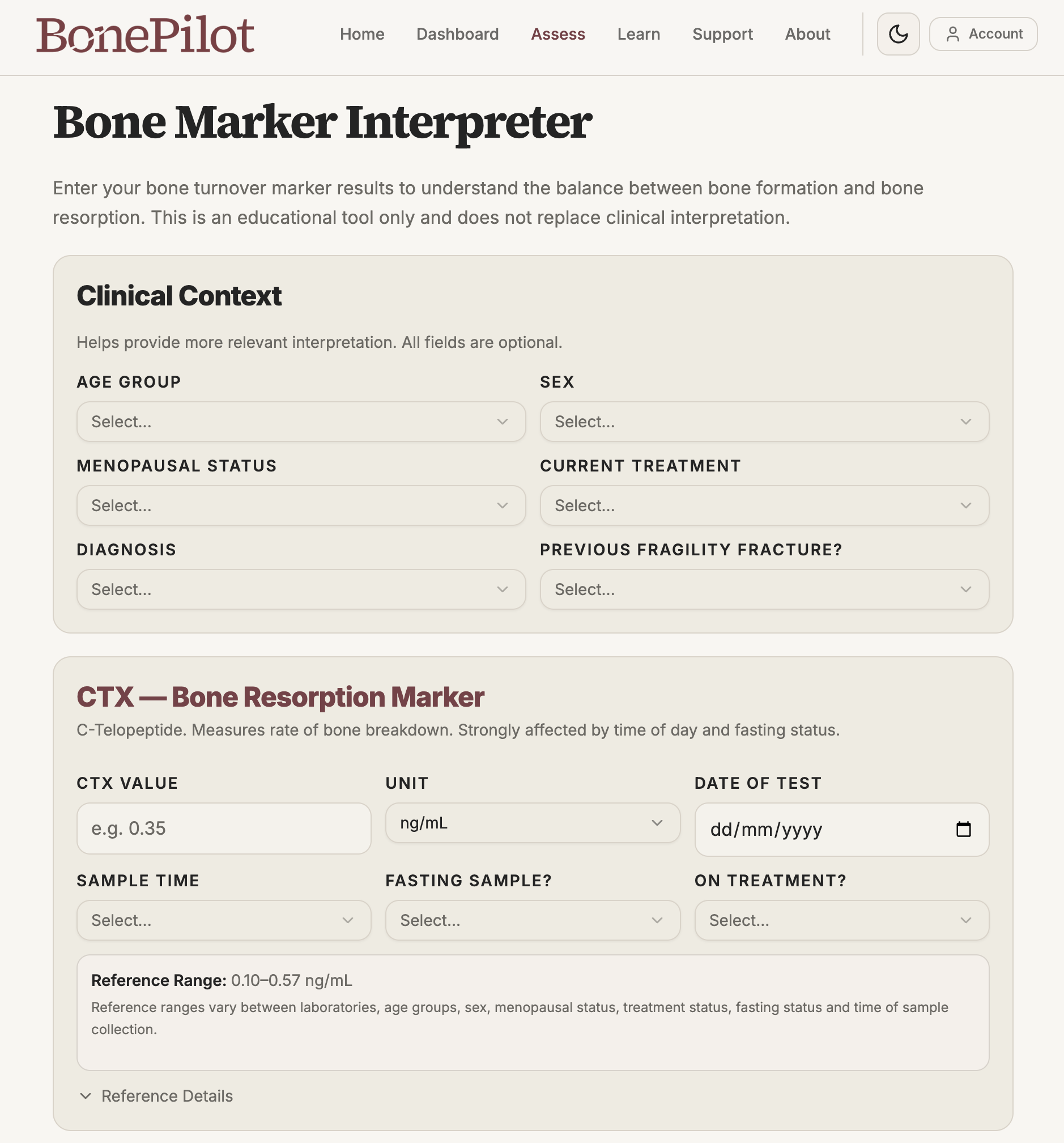
Simply enter your CTX and P1NP values into the Bone Turnover Marker Assessment, and BonePilot will place your results on an easy-to-understand visual chart, showing whether your bone turnover appears low, balanced or high, together with an educational explanation of what that pattern may suggest.
One Part of a Bigger Picture
As Dr Doug Lucas emphasises, bone turnover markers are only one part of the picture. They should always be interpreted alongside your DEXA scan, fracture history, medications, blood tests, nutrition, exercise habits and overall clinical context (1,3). That's exactly the philosophy we're building into BonePilot.
Research Papers Referenced
★★★★☆ Position Paper — Vasikaran S, Eastell R, Bruyère O, et al. Markers of bone turnover for the prediction of fracture risk and monitoring of osteoporosis treatment: a need for international reference standards. Osteoporos Int. 2011;22(2):391–420. PubMed · DOI: 10.1007/s00198-010-1501-1
★★★★☆ Prospective Cohort Study — Borgen TT, Solberg LB, Lauritzen T, Apalset EM, Bjørnerem Å, Eriksen EF. Target Values and Daytime Variation of Bone Turnover Markers in Monitoring Osteoporosis Treatment After Fractures. JBMR Plus. 2022;6(6):e10633. PubMed · DOI: 10.1002/jbm4.10633
★★★★★ Systematic Review & Consensus Paper — Bhattoa HP, Vasikaran S, Trifonidi I, et al. Update on the role of bone turnover markers in the diagnosis and management of osteoporosis: a consensus paper from ESCEO, IOF, and IFCC. Osteoporos Int. 2025;36(4):579–608. PubMed · DOI: 10.1007/s00198-025-07422-3
★★★☆☆ Observational Study — Fisher A, Srikusalanukul W, Fisher L, Smith PN. Lower serum P1NP/βCTX ratio and hypoalbuminemia are independently associated with osteoporotic nonvertebral fractures in older adults. Clin Interv Aging. 2017;12:1131–1140. PubMed · DOI: 10.2147/CIA.S141097
★★★☆☆ Observational Study — Fisher A, Fisher L, Srikusalanukul W, Smith PN. Bone Turnover Status: Classification Model and Clinical Implications. Int J Med Sci. 2018;15(4):323–338. PubMed · DOI: 10.7150/ijms.22747
As BonePilot continues to evolve, I'll keep expanding its scientific library with additional randomised controlled trials, systematic reviews and meta-analyses so that Claude's educational explanations are grounded in the best available evidence.
Related Articles
Disclaimer: BonePilot provides educational information and decision-support tools. It is not intended to diagnose, treat or replace advice from your doctor or other qualified healthcare professional.
Estimated reading time: 4 minutes
