
Why I Went Back to Organic Full Fat Milk After Nearly 10 Years as a Vegan
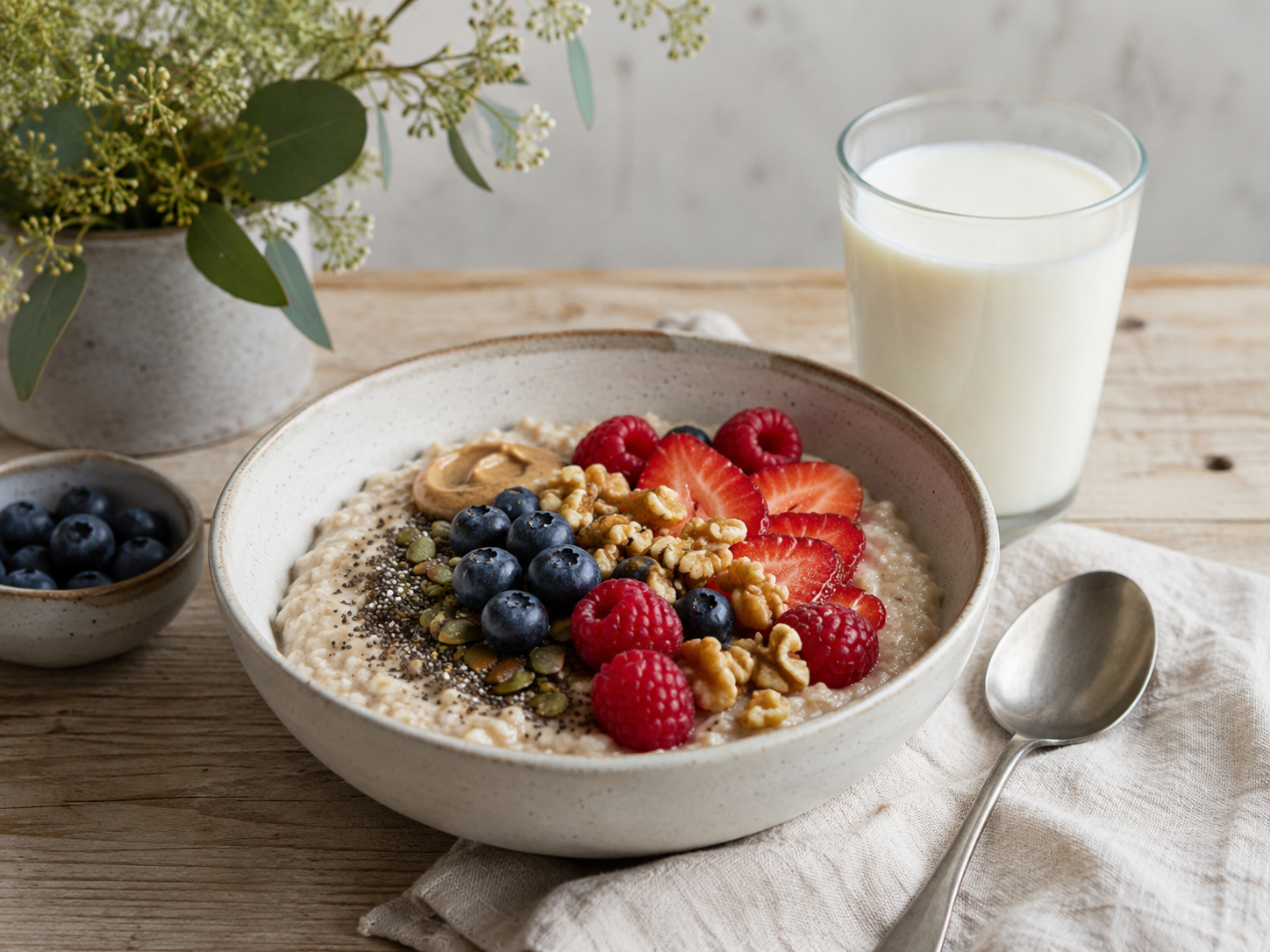
A glass of organic whole milk alongside a bowl of porridge — a small daily habit with a much bigger backstory.
Changing your mind isn't a failure. Sometimes it's the most rigorous thing you can do.
Why I Changed My Mind
Changing your opinion isn't always easy, especially about something you've believed for years. For almost ten years I followed a vegan diet — vegetables, legumes, nuts, seeds and plant-based alternatives — and I genuinely believed it was the healthiest choice I could make. Then life changed. After being diagnosed with severe osteoporosis, together with several vertebral compression fractures, I found myself asking a difficult question: what if I need to rethink everything I thought I knew about nutrition? Instead of looking for evidence to support my existing beliefs, I decided to do the opposite — I followed the science wherever it led.
Following the Evidence, Not the Ideology
One of the biggest lessons I've learned during my recovery is that nutrition should never become an ideology — it should remain evidence-informed. As I read more of the literature on bone health, I realised that building and maintaining healthy bone depends on far more than calcium alone. Adequate dietary protein is now recognised as an essential, independent contributor to bone mass and fracture risk, not just a muscle-building nutrient (1,2). Older adults in particular are advised to consume more protein than general population guidelines suggest, specifically to protect bone and lean tissue (3). Alongside protein, vitamin D, phosphorus, magnesium and vitamin K all play supporting roles in bone metabolism. That reading led me to reconsider one food I hadn't touched in years: organic whole milk.
Evidence Snapshot
Overall Evidence Quality: ★★★★☆ High. The role of dietary protein in bone health is well established through systematic review and international position-paper consensus (1,2,3). Calcium bioavailability from dairy is one of the most extensively studied areas in nutrition science (4). The nutritional gap between cow's milk and most plant-based alternatives is also well documented (5) — though evidence on long-term fracture outcomes specifically tied to vegan-versus-dairy-inclusive diets remains more limited.
Why Organic Milk?
For me, organic whole milk offered several advantages in a single glass. A typical 250 ml serving naturally provides a meaningful package of nutrients:
Estimated Nutritional Values (per 250 ml organic whole milk)
Rather than juggling several supplements or relying only on fortified alternatives, milk delivers many of these nutrients together, in a food that's been part of human diets for generations. That simplicity appealed to me. It also matters that the calcium in dairy is genuinely well absorbed: lactose and casein-derived compounds in milk actively enhance calcium uptake in the gut, which is part of why dairy calcium performs so consistently well in bioavailability research (4).
BonePilot Insight
Wondering how your own calcium and protein intake stacks up? Use the Daily Calcium Intake Calculator and Protein Intake Calculator to see where you stand, and the Supplements Assessment if you're weighing up whether you need to supplement at all.
What About Plant-Based Alternatives?
Plant-based drinks have improved enormously over the past decade, and many oat, almond and soya drinks are now fortified with calcium and vitamin D — genuinely useful options for people who can't or choose not to consume dairy. But a direct nutritional comparison shows they aren't interchangeable (5):
Protein Comparison: Milk vs. Plant-Based Alternatives (per ~240 ml, unsweetened)
Protein comparison per approximately 240 ml, unsweetened.
Fortified soy milk comes closest to matching cow's milk, largely because of its comparable protein content (5). Oat drinks generally contain less protein, almond drinks are low in both protein and calories, and rice drinks are predominantly a carbohydrate source with very little protein at all. For someone actively trying to protect bone health, that gap matters.
My Decision
I didn't return to drinking milk because I believe dairy is essential, and I don't think everyone should make the same decision. I returned because, after reviewing the evidence and considering my own diagnosis, it made sense for me. Today I choose organic whole milk, organic Greek yoghurt and a moderate amount of carefully selected cheeses, as part of a balanced Mediterranean-style diet. It's a decision based on my current understanding of the science — not habit, emotion or ideology.
What I Learned
Perhaps the most important lesson wasn't about milk at all — it was about being willing to change. Good science asks us to stay curious. Sometimes new evidence confirms what we already believe, and sometimes it challenges us. If we're willing to adapt either way, we tend to make better decisions.
How Strong Is the Evidence?
Well supported: the role of adequate dietary protein in maintaining bone mass and reducing fracture risk (1,2,3); the strong bioavailability of calcium from dairy sources (4); the meaningful protein gap between cow's milk and most plant-based alternatives, aside from fortified soy (5).
Emerging evidence: how these individual nutrient findings translate into real-world fracture outcomes specifically for people transitioning from vegan to dairy-inclusive diets.
Still under investigation: long-term, head-to-head fracture-risk data comparing lifelong vegan diets against dairy-inclusive diets in osteoporosis populations.
Practical Takeaways
Don't treat any diet as an identity — treat it as a hypothesis you're willing to test against new evidence.
Protein is a bone nutrient, not just a muscle nutrient — make sure you're getting enough of it.
If you rely on plant-based milk, check the label: fortified soy is nutritionally closest to cow's milk, most others are not.
Dairy calcium is well absorbed, but it isn't the only route to adequate calcium — the right choice depends on your full diet, not one food in isolation.
Revisit your own assumptions periodically, especially after a new diagnosis or new evidence.
BonePilot Tools Mentioned
Daily Calcium Intake Calculator — estimates your daily calcium intake from diet and supplements.
Protein Intake Calculator — checks whether your daily protein intake supports bone and muscle health.
Supplements Assessment— helps you review whether your current supplement routine actually fills your dietary gaps.
Explore BonePilot:
Final Thoughts
If you'd asked me five years ago whether I'd ever drink milk again, I would have said no. Today I happily pour organic milk over my morning porridge — not because someone convinced me, and not because I abandoned my values, but because I chose to follow the evidence. Living with osteoporosis has taught me that health isn't about defending old beliefs; it's about continually learning, asking better questions, and making the best decisions you can with the information available today. If future research points in a different direction, I'll adapt again. The goal was never to prove I was right. It has always been to build the strongest, healthiest bones I can.
This article reflects my personal experience and interpretation of current scientific evidence. It's intended for educational purposes only and does not replace personalised medical advice from your healthcare professional.
Related Articles
Scientific References
★★★★☆ Review — Bonjour JP. Dietary protein: an essential nutrient for bone health. J Am Coll Nutr. 2005;24(6 Suppl):526S–536S. Read on PubMed
★★★★★ Systematic Review & Meta-Analysis — Darling AL, Millward DJ, Torgerson DJ, Hewitt CE, Lanham-New SA. Dietary protein and bone health: a systematic review and meta-analysis. Am J Clin Nutr. 2009;90(6):1674–1692. Read on PubMed
★★★★☆ Position Paper — Bauer J, Biolo G, Cederholm T, et al. Evidence-based recommendations for optimal dietary protein intake in older people: a position paper from the PROT-AGE Study Group. J Am Med Dir Assoc. 2013;14(8):542–559. Read on PubMed
★★★★☆ Review — Guéguen L, Pointillart A. The bioavailability of dietary calcium. J Am Coll Nutr. 2000;19(2 Suppl):119S–136S. Read on PubMed
★★★★☆ Comparative Review — Vanga SK, Raghavan V. How well do plant based alternatives fare nutritionally compared to cow's milk? J Food Sci Technol. 2018;55(1):10–20. Read on PMC
Estimated reading time: 7 minutes
